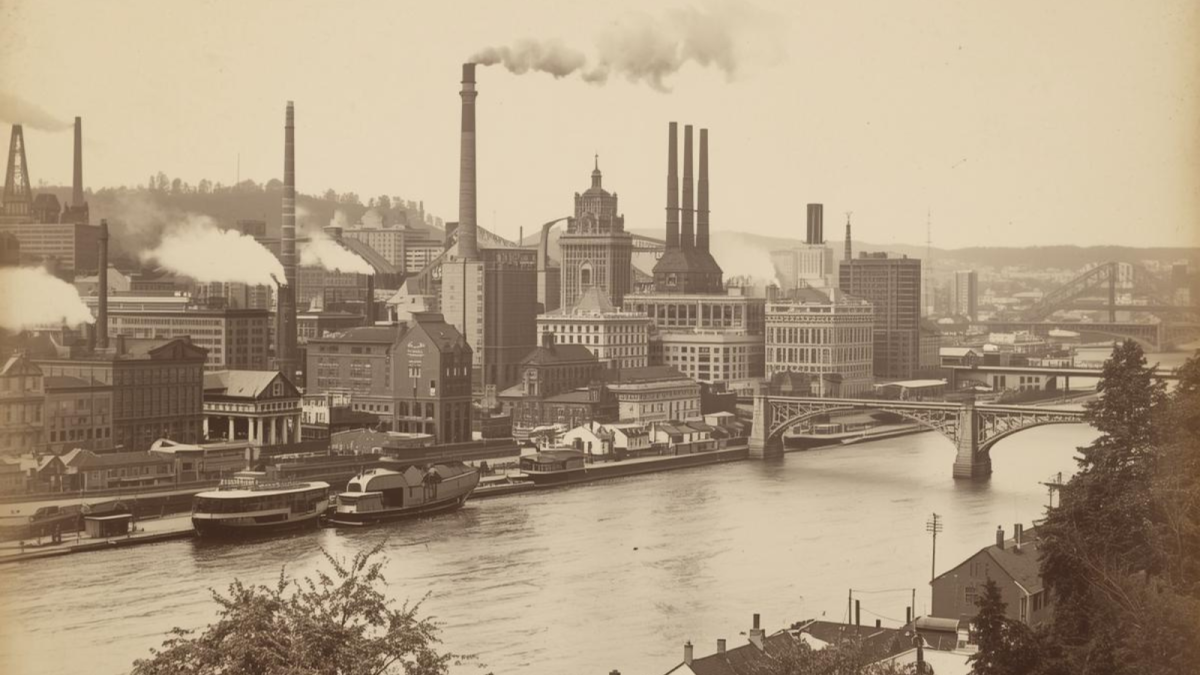
(Grant Street, 1892)
The office smells of metal and oil and paper gone soft at the edges.
Janey sits at her desk before the others arrive, the telegraph key cool beneath her fingers. She likes the quiet then — before the men from the freight lines begin sending their long bursts of code, before the air fills with the tapping like rain on a roof.
The room is long, high-ceilinged, with gas lamps still burning though the dawn now shows faint through the frosted windows. Below, the streetcars clatter toward Market Square. She can see the tops of their poles sparking blue against the wires.
She begins her first message: a routine dispatch for the Pennsylvania Railroad, the letters tumbling through her hand in rhythm — click-click-click, pause, click-click. The sound steadies her. It’s familiar.
Her fingers ache sometimes from the key, the stiff brass of it, but she doesn’t mind. She imagines the dots and dashes flying down the lines — past bridges, over rivers, through towns she’ll never see. When she was a girl she thought of messages as tiny lights, running fast through the dark. She still likes to think that.
The supervisor enters, nods once, hangs his hat. He’s a square man with a cough that shakes his whole body. He says morning without looking at her. The other operators arrive, men mostly, smelling of tobacco and damp wool. Their voices fill the room. Someone laughs too loudly.
Janey keeps her eyes on the key.
By mid-morning the wires are alive. She copies incoming code onto message blanks, her pen flying. Most are dull — bills, prices, deliveries, names. The men joke about the mills upriver, the wages were cut again. Someone says there’ll be trouble soon. She keeps writing.
Sometimes a message comes marked PRIVATE, and she reads only what duty demands. But the words stay with her — fragments of other lives, caught like bits of light:
Dearest—
Forgive delay—
Arrive Thursday if weather holds.
Once she received a note that ended, Tell him the roses came late but are still beautiful.
She had copied that one slowly.
At noon she takes her lunch by the window — bread, an apple, a small tin of tea. Across the way, a man sells violets from a wooden cart. The flowers look out of place against the gray. She wonders who buys them.
A faint ringing comes through the receiver: another line opening, distant. She returns to the key. The message is short, unremarkable. She copies it, signs the initials, sends it through the pneumatic tube. When she looks up again, the man with the cart is gone.
The afternoon stretches long. Light slides across the floor, golden where it strikes the brass instruments. Janey’s eyes blur. She thinks of her mother lighting candles at St. Paul’s, the smell of wax and smoke rising together. Her mother had said the telegraph gave men too many voices. Janey isn’t sure. Sometimes, when the lines are busy and the sound fills the room until it seems to thrum in her blood, she thinks it might be something close to Mass — a kind of communion of souls, thin and bright.
Near four o’clock, a message comes through on the Chicago line. The rhythm is slower, hesitant, as if the operator’s hand trembles. She writes it carefully:
To J. Callahan, Pittsburgh Dispatch Office.
Will arrive on evening train. Stop. Hope all is well. Stop.
She hesitates. That’s her name.
For a moment she can’t breathe.
She checks the ledger — there’s a John Callahan, a clerk in the accounting room below. She should route it to him. She knows that. Still, she reads the words again before she folds the slip. They’re plain words, ordinary. Yet they strike through her like a chord half-remembered.
Will arrive. Hope all is well.
She wonders what it would be like to have someone send such a line to her — nothing elaborate, just that small care crossing the wires. She imagines the man on the other end: a coat dusted with snow, fingers red from the key, waiting for the sound of her reply.
She places the message in the carrier tube and watches it vanish into the wall. The air hisses shut.
The room quiets as evening comes. Lamps are lit again; the glass globes glow soft yellow. Outside, smoke drifts low over the river. The supervisor closes the ledger, coughs, leaves. One by one, the others follow.
Janey stays to finish the last report. The wires tick faintly in the stillness. The sound is softer now, almost tender.
She removes her gloves, flexes her fingers, and rests them on the key one final time. The brass is warm from the day’s work. She sends a test pulse down the line — a meaningless string of letters, a habit — and listens for the echo that does not come.
In the silence that follows, she thinks of all the messages she has sent and will send, moving unseen through darkness, passing fields and rivers and sleeping towns. Somewhere out there, she imagines, one might break loose — a wayward spark — and find its way back to her.
She blows out the lamp. The smell of oil lingers. On her way down the stairs, she hums a tune she cannot name. Outside, the streetcar rattles past, and the night closes in around her — bright with hidden voices.